
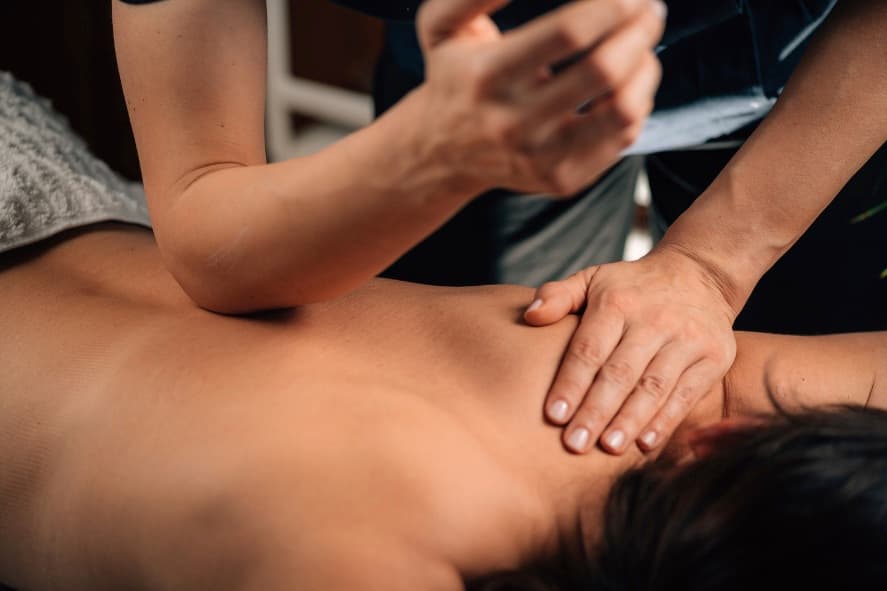
Deep Tissue Massage
Breathe. Relax. Let go. Firm pressure, slow strokes, targeted work. Deep tissue massage that actually reaches the muscle tension you’ve been carrying — performed by licensed therapists trained specifically in deep tissue technique. Not a glorified Swedish. The real thing.


Deep tissue massage is a therapeutic technique that uses firm pressure and slow, focused strokes to reach the deeper layers of muscle and connective tissue. It’s designed for chronic tension, postural issues, athletic recovery, and muscular pain that lighter massage can’t touch. At Pristine, every deep tissue massage is performed by a Florida-licensed massage therapist with specific deep tissue training — not a Swedish therapist pressing harder when you ask. The techniques, the pacing, and the therapeutic focus are genuinely different. If you’ve ever booked “deep tissue” somewhere and left feeling like it was just a firm Swedish massage, you’ve been cheated. This is what it’s actually supposed to be.
What Makes Pristine Deep Tissue Different
Therapists specifically trained in deep tissue technique.
Deep tissue isn’t just “Swedish with more pressure.” It uses distinct techniques — slow stripping, cross-fiber friction, trigger point work, and sustained compression — that require specialized training. Every deep tissue massage at Pristine is performed by a licensed therapist whose continuing education includes specific deep tissue modalities.
Real communication about pressure.
Deep tissue should be intense but never traumatic. Your therapist checks in throughout — pressure dial adjusted in real time. “Good hurt” is fine; “bad pain” means we back off immediately. No macho posturing, no white-knuckling through a session that should be productive.
Targeted work, not blanket deep pressure.
A good deep tissue session doesn’t press hard on every inch of your body. It identifies specific areas of chronic tension — shoulders, low back, hip flexors, neck, glutes — and focuses time there. Less effective on areas that don’t need it. More effective where it matters.
Integrated with your actual lifestyle.
Your therapist asks about your work, your posture, your sleep, your stress, and your training load. Desk workers get different treatment than runners. Mothers of young kids get different focus areas than construction workers. The work is built around what’s actually causing your tension.
Progress over single-session miracles.
One deep tissue session is good. A series is transformational. We talk honestly about how often you should come in — weekly for chronic issues, biweekly for maintenance, monthly for general prevention — and build a plan.
Recovery protocol after.
We send you home with hydration guidance, stretching recommendations, and heat/cold therapy protocols specific to the areas we worked. Your session doesn’t end when you leave the table.
What Is Deep Tissue Massage — and What It’s Not
Deep tissue IS:
- Slow, focused work using firm pressure
- Stripping along the grain of specific muscles
- Cross-fiber friction across muscle fibers
- Sustained compression on trigger points
- Work that reaches 2–3 layers below the surface muscle
- Therapeutic — aimed at resolving actual dysfunction
Deep tissue is NOT:
- Painful the entire time (productive discomfort is NOT constant agony)
- Full-speed elbow-grinding (that’s sports massage or aggressive bodywork)
- Always harder than Swedish (it’s different, not just “more”)
- Good for first-time massage clients (start with Swedish, build up)
- Appropriate for every body (see contraindications)
- A magical one-session fix (think series, not silver bullet)
If your deep tissue therapist is just pressing hard the whole session without the slow, focused technique — you’re not actually getting deep tissue. You’re getting firm Swedish. Legitimate deep tissue feels distinctly different.
Benefits of Deep Tissue Massage
- Chronic tension relief — targets the stuff that doesn’t resolve with rest
- Postural correction support — addresses the muscle imbalances behind bad posture
- Athletic recovery — flushes metabolic waste, reduces DOMS, restores range of motion
- Scar tissue breakdown — helps mobilize restrictive tissue from old injuries
- Low back pain reduction — one of the most-studied clinical uses
- Neck and shoulder release — essential for desk workers, drivers, parents of young kids
- Hip flexor and glute work — essential for sitters, runners, and anyone with back issues
- Sleep quality improvement — muscular tension is a leading cause of poor sleep
- Reduced headache frequency — tension headaches are often muscular in origin
- Better mobility and flexibility — freed tissue moves better
- Stress reduction — even though it’s intense, the parasympathetic effect is real
Who Comes to Pristine for Deep Tissue
- Desk workers with chronic neck, shoulder, and upper back tension
- Runners and athletes in training cycles
- Postpartum clients (after OB clearance) with residual tension from pregnancy posture
- Drivers, pilots, and anyone in extended sitting
- Weightlifters and CrossFit athletes
- Construction, trades, and manual labor workers
- Nurses, teachers, and standing-all-day professionals
- Clients with chronic low back pain
- Clients recovering from injury (after acute phase)
- Clients with repetitive strain issues
- Stressed executives and high-performers
- Anyone with “tight hips,” “tight hamstrings,” or “knots in my traps”
- Clients transitioning off chiropractic care and looking for muscular maintenance
- Clients who’ve tried “deep tissue” elsewhere and were disappointed
Who Isn’t a Good Candidate
Deep tissue isn’t appropriate for everyone. Contraindications include:
- Acute injury or inflammation — during the injury’s acute phase (first 48–72 hours)
- Blood clots or history of DVT — deep pressure risks dislodging clots
- Bleeding disorders or anticoagulant medication — without physician clearance
- Severe osteoporosis — deep pressure on compromised bone is risky
- Active skin infections in the treatment area
- Recent surgery in the treatment area (wait for clearance)
- Pregnancy — prenatal massage is the right service instead
- Severe cardiovascular disease — requires physician approval
- Active cancer treatment — requires oncologist clearance
- Severe autoimmune flares
- First-time massage clients with no tolerance built up — start with Swedish
If you have any of the above, we’ll recommend alternatives: Swedish massage, prenatal massage (if applicable), lymphatic drainage, or cupping depending on your situation.
Best practice: First-time massage clients start with Swedish. Regular clients who’ve built tolerance and have specific tension issues upgrade to deep tissue. Many clients alternate — deep tissue every other session for therapeutic work, Swedish in between for recovery.
What to Expect During Your Deep Tissue Session
- 1.Intake + consultation — Your therapist reviews your health history, medications, current pain or tension areas, lifestyle, and goals. Be specific — “my traps are tight” is more useful than “I’m sore.”
- 2.Focus areas identified — Your therapist plans the session around your priorities. 60-minute sessions typically focus on 2–3 specific areas; 90-minute sessions allow broader work.
- 3.Privacy for undressing — You undress to your comfort level and get under sheets on the table. Proper draping protects modesty throughout.
- 4.Warm-up work (first 5–10 min) — Your therapist starts with lighter pressure to warm the muscles — deep tissue on cold muscles is ineffective and painful.
- 5.Deep work begins — Slow, focused pressure. Your therapist identifies specific tension areas and works through them systematically. You’ll feel pressure, discomfort in knots, and release as tissue softens.
- 6.Communication throughout — Your therapist asks about pressure regularly. Speak up immediately if pressure is too much — we adjust in real time.
- 7.Breathing coaching — Deep tissue work responds best to deep, slow breathing. Your therapist may cue breathing for particularly tight areas.
- 8.Session closure (last 5–10 min) — Lighter finishing work integrates the deeper therapy and eases you out of the session.
- 9.Post-session recommendations — Hydration, stretching, and heat/cold guidance for the areas worked.
Pre-Session Prep
- Hydrate heavily day-of and day-before
- Eat a light meal 1–2 hours before (not a full meal, not empty stomach)
- Avoid caffeine and alcohol 2–3 hours before
- Skip intense workouts day-of
- Communicate your goals clearly — tell your therapist what hurts, where, and why you think
- Shower before so tissue is clean (and you feel better laying down)
- Dress comfortably for the drive home — you’ll be relaxed
Post-Session Care
- Hydrate aggressively for 24 hours — 80–100 oz of water. Deep tissue work mobilizes waste from tissues; water flushes it.
- Expect 24–48 hours of soreness — like a hard workout. This is normal. Ibuprofen or acetaminophen is fine.
- Gentle heat or cold therapy — use cold on acute areas (first 24 hours), heat on chronic tension (after 24 hours).
- Gentle stretching — NOT aggressive. Just movement through full range of motion.
- Skip intense exercise for 24 hours
- Extra sleep — your body is doing recovery work
- Monitor how you feel over the next 3–5 days — if soreness persists past 72 hours, tell us at next session
- Rebook based on your plan — weekly for acute issues, biweekly for maintenance, monthly for general prevention
Deep Tissue Massage Frequency Guide
How often you should book depends on your situation:
Weekly
For acute chronic pain, postural correction programs, or athletes in heavy training.
Biweekly
For significant chronic tension with manageable symptoms.
Monthly
For maintenance and general prevention.
Quarterly
For clients with no major tension issues but wanting occasional reset.
Talk to your therapist about your right cadence. Most clients start more frequent (weekly/biweekly) for 4–6 sessions, then taper to monthly maintenance as the major tension resolves.
The Pristine Membership
Members receive one hour of massage therapy or a facial every month — your choice, every month — plus member-only pricing on additional services and priority booking across all three locations. One flat monthly rate. No contracts. The membership has been part of Pristine since day one because consistent clients deserve consistent value.
Learn More About MembershipsPristine Membership gets you one service per month at member pricing, rollover credits, guest passes, and priority booking. Many regular deep tissue clients use membership for their monthly session, stacking guest passes or paying out of pocket for more-frequent sessions during stressful periods.
Treat Now, Pay Later
We offer flexible financing through Cherry, CareCredit, and Allē so cost doesn't stand between you and the treatment you want. Apply online before your appointment or ask at booking.
View Payment PlansBreak massage packages into monthly payments with Cherry, CareCredit, or Allē. Soft credit check, decisions in seconds.
Our licensed estheticians are trained at Pristine Beauty Academy, our own accredited school offering esthetics, laser, and nail licensing programs in the Central Florida area. Pristine Beauty Academy
Many of our licensed massage therapists trained at Pristine Beauty Academy, our accredited esthetics, laser, and nail school — though massage therapy is a separate licensure. Deep tissue is an advanced modality our therapists pursue as continuing education beyond base licensure.
Frequently Asked Questions
Para Nuestros Lectores en Español
Un tratamiento terapéutico realizado por terapeutas licenciadas usando presión firme y movimientos lentos y enfocados para aliviar la tensión crónica, el dolor postural y la recuperación atlética. Comunicación constante sobre la presión. Respira, relájate, y déjate llevar.
Related Services
Pristine’s deep tissue massage pairs or alternates with other massage and recovery services.
Swedish Massage
Lighter alternative for relaxation or between deep tissue sessions.
Sports Massage
Performance-oriented, event-specific alternative.
Lymphatic Drainage
Different purpose — flushing/recovery rather than muscle work.
Cupping
Complementary add-on for stubborn chronic tension.
Prenatal Massage
Alternative for pregnant clients.
Couples Massage
Book deep tissue as part of a couples session.
Three Florida Locations. Real Deep Tissue — Done Right.
Licensed therapists with specific deep tissue training. Real communication. Real technique. Therapeutic, not performative. If you want it done right, you make the trip to Pristine.